Useful repair is not only a faster parameter update. The system must identify a consequential gap, compile a bounded correction, choose enough evidence to distinguish it from plausible alternatives, and govern the resulting model version.
Two small physical changes that make deployed models wrong
The first experiment used the public TD-MPC2 walker-walk controller. One left-leg motor command channel changed polarity: a positive command that previously pushed one way now produced the opposite physical effect. The task and public command interface stayed unchanged, so the frozen dynamics model planned for the wrong world and failed all 32 confirmation tasks.
The second experiment reused the sealed MuJoCo Reacher model. Its first motor still received the same command, but only 40% of the requested torque reached the arm; the second motor was unchanged. Here the question was no longer whether the correction could work. It was whether IWMR could verify it with one deliberately selected interaction instead of a fixed 16-action test.
A reversed or weakened actuator is simple enough to audit exactly, but it has the structure of real deployment drift: the observation and command names remain familiar while the consequences of action change.
What the six TD-MPC2 video panels mean
The video replays the same changed walker under six update strategies. Frozen keeps the deployed model unchanged. Context applies the authorized correction only for the current decision; it works, but creates no persistent verified version, provenance chain or rollback target. The 1-param adapter learns one scalar from 32 post-change transitions through 200 optimization steps.
Full fine-tuning performs 200 bounded updates on the public TD-MPC2 model. IWMR compiles the same bounded answer into a typed local transform, verifies it against public evidence, creates an immutable model version and retains the old route. Exact is an evaluation-only oracle: it receives the true transform so we can tell whether the correction itself is sufficient.
| Strategy | Tasks recovered | Median update | Persistent governed version |
|---|---|---|---|
| Frozen | 0/32 | No update | No |
| Context | 32/32 | 7.95 ms | No |
| 1-param adapter | 32/32 | 253 ms | Learned weights; no IWMR version |
| Full fine-tuning | 0/32 | 4.382 s | No IWMR version |
| IWMR | 31/32 | 8.48 ms | Yes |
| Exact reference | 32/32 | Evaluation only | No |
A 516.6× update result—and one correct abstention too many
IWMR detected all 32 changes, verified and committed 31 local repairs, and recovered 31 tasks. Frozen and the registered 200-step full fine-tuning baseline recovered none. Median complete IWMR update time was 8.48 milliseconds versus 4.382 seconds for full fine-tuning: 516.57 times lower in this implementation.
The protocol passed 8 of its 10 registered gates, but the required all-gates conjunction remained FAIL. In one world the correct candidate beat the strongest wrong-channel alternative by 3.37%, below the frozen 5% specificity boundary. IWMR safely abstained; the exact reference recovered the task. Because the protocol required every task, that abstention left two gates unmet: candidate acceptance and no-loss task recovery.
Context and the one-parameter adapter both achieved 32 of 32. Context was slightly faster than IWMR, while the adapter remained roughly 30 times slower. The defensible result is therefore not universal strategy dominance. It is fast, governed local repair with one conservative miss under a frozen verifier.
A transient correction can be operationally useful. IWMR adds the harder deployment properties: evidence attribution, verification before mutation, immutable child versions, explicit routing, nominal retention and exact rollback.
The next question: can the model choose its own verification test?
The earlier Reacher protocol always executed the same 16-action probe. SEA-1R instead gave the verifier a frozen library of 16 safe one-motor actions. Before commit, the model selected the action with the largest minimum predicted disagreement between the authorized 40% correction and four alternatives: unchanged dynamics, the wrong motor, and two wrong magnitudes.
Selection could use only the public initial state, frozen predictor, answer-defined candidate, registered alternatives and action library. It could not read hidden actuator authority, effective action, reward, task outcome or exact-reference metrics. The observed next state became immutable evidence inside the candidate version.
Sixteen interactions became one; planning matched the exact correction
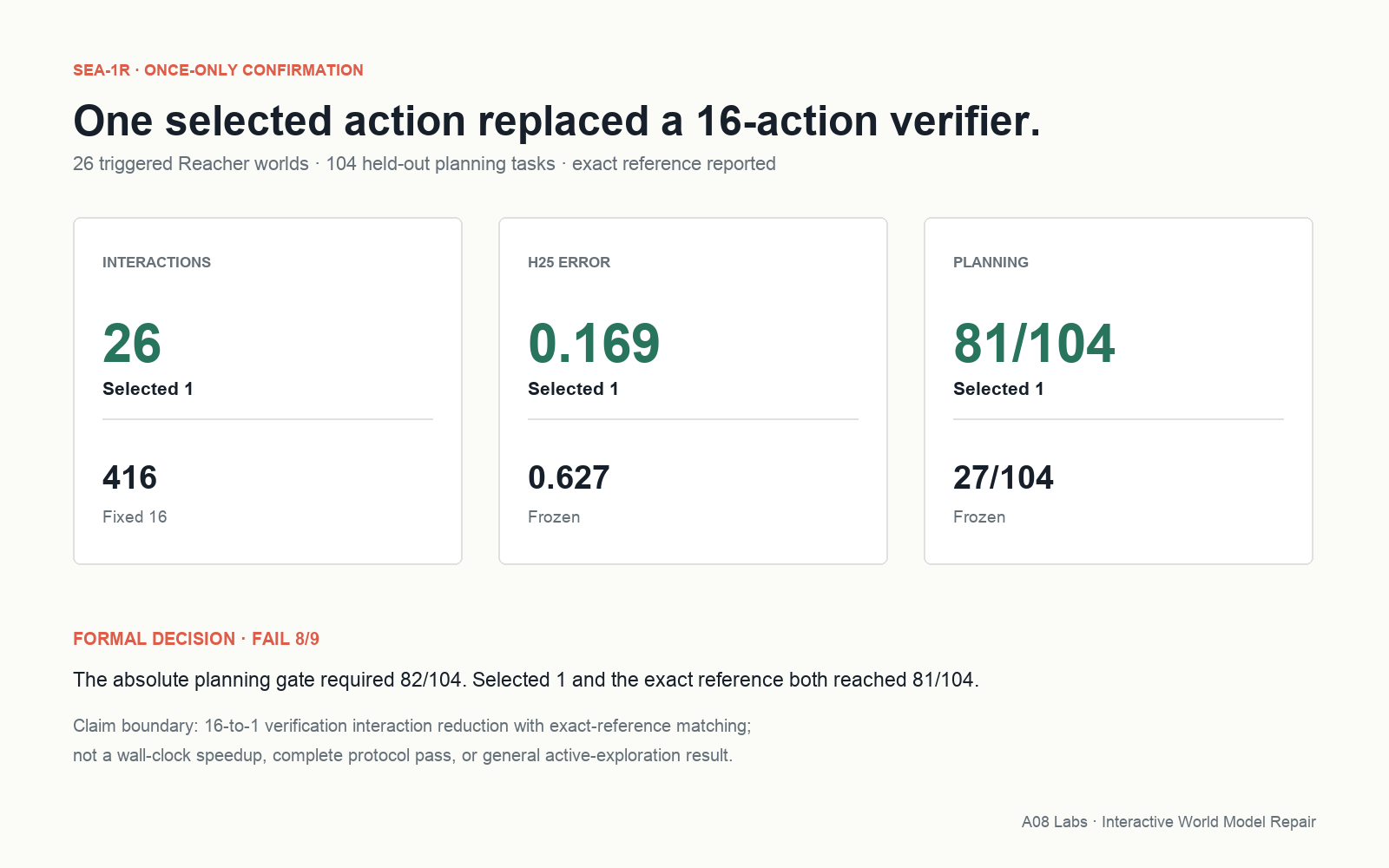
On 32 fresh changed worlds, 26 produced a public mission failure and opened repair. Selected 1 verified and committed all 26 correct candidates with zero incorrect commits. It consumed 26 verification transitions; Fixed 16 consumed 416 and reached the same decisions. A deterministic Random 1 baseline accepted only 14 of 26 candidates, so an arbitrary one-action test was not equivalent.
H25 prediction error fell from 0.62735 frozen to 0.16929 repaired, exactly matching the evaluation-only correction. Planning rose from 27 of 104 tasks to 81 of 104, again exactly matching the reference. Thirty-two nominal controls spent zero questions and commits; all eight invalid-provenance cases abstained before the question or probe.
| Strategy | Accepted | Verification interactions | H25 error | Planning |
|---|---|---|---|---|
| Frozen | — | 0 | 0.62735 | 27/104 |
| Random 1 | 14/26 | 26 | 0.39479 | 60/104 |
| Fixed 16 | 26/26 | 416 | 0.16929 | 81/104 |
| Selected 1 + IWMR | 26/26 | 26 | 0.16929 | 81/104 |
| Exact reference | — | Evaluation only | 0.16929 | 81/104 |
Why exact-reference matching still produced an overall FAIL
The confirmation required Selected 1 planning to reach at least 78% of every triggered evaluation task. With 104 tasks, the frozen implementation of that gate was ceiling of 0.78 times 104: 82 successes. Selected 1 and the exact reference both reached 81, or 77.88%. The protocol therefore failed by one mission.
The protocol therefore passed 8 of 9 registered gates, but its required all-gates decision remained FAIL. This result cannot be retroactively converted into an overall pass just because the selected repair exactly matched the reference. It does establish the registered descriptive observation: one selected verification action replaced 16 fixed actions while retaining the same repair decisions, H25 prediction and task-level planning outcomes.
On 26 triggered Reacher confirmation worlds, IWMR cut verification interaction from 16 actions to one and exactly matched the evaluation-only correction across 104 planning tasks. Eight of nine registered gates passed; the overall decision remained FAIL because both reached 81/104 against an 82-task floor.
What this adds to the A08 thesis
The O2-W result makes the repair loop tangible on a public controller: the world changes, the deployed model fails, and a small governed correction restores behavior hundreds of times faster than the registered fine-tuning baseline. The comparison also exposes why speed alone is insufficient: transient context and a tiny learned adapter are strong alternatives.
SEA-1R advances a different bottleneck. In real systems, evidence has a cost. A robot may need to move, a process may need to be perturbed, or an operator may need to pause production. Choosing one high-information test instead of executing a fixed battery is a path toward lower-intervention repair.
The remaining work is to reproduce selective acquisition on a new public model family where passive evidence is genuinely ambiguous, selected actions vary with context, and the complete absolute competence conjunction passes. Neither experiment establishes physical transfer, general active exploration or autonomous law commitment.
Combined totals are descriptive unless the article explicitly says they were a preregistered pooled gate. Machine timings describe the measured local implementation. A failed conjunction remains failed even when several sub-results are positive.