Repairing world models was only the beginning.
A08 Labs started by asking how a deployed world model could recover when the world changes. Answering that question revealed a larger opportunity: building the complete industrial system around it.
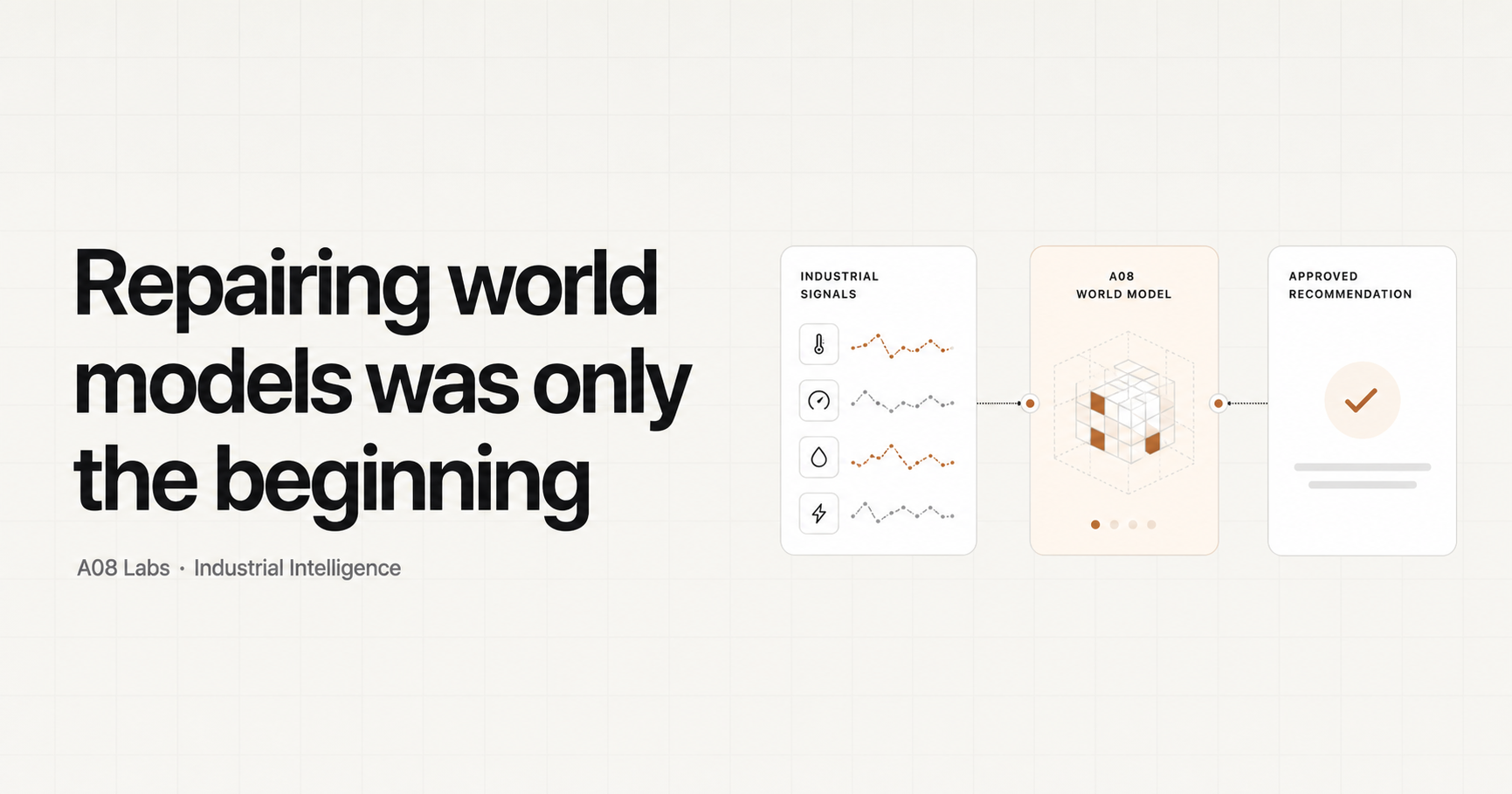
Industrial operations constantly make decisions whose consequences unfold over time. A conveyor speed affects throughput. A temperature profile affects quality and energy consumption. A scheduling choice changes how resources will be used several steps later.
Existing control systems, operator experience and engineering studies remain essential. What they do not always provide is a model that can answer one practical question: what is likely to happen if we take this action now?
This is where world models become useful. They learn how the current state of a system and an action produce future states and operational outcomes. Instead of only reporting what happened, they can evaluate possible decisions before those decisions reach the process.
01 · The starting point
Models become wrong.
A model is trained under a particular operating regime. After deployment, equipment wears, materials change, actuators lose authority and relationships between commands and outcomes evolve. Most of the system may remain correct while one local assumption is no longer true.
A08 started with a focused research question: when a deployed world model becomes wrong after a hidden change, can we repair it without retraining the entire model?
Can a model detect a consequential gap, obtain the smallest useful correction and restore prediction and planning through a verified, reversible update?
That research became Interactive World Model Repair, or IWMR. It detects a mismatch, prepares a local typed correction, verifies the candidate before activation and creates an explicit model version with rollback.
The objective is not to let an AI rewrite itself freely. It is to make adaptation observable, governed and reversible.
02 · What IWMR established
A repair mechanism became a working system.
Our principal confirmed result used an action-conditioned dynamics model in the official Gymnasium MuJoCo Reacher environment. A hidden change reduced the effect of one actuator: the command remained valid, but it no longer produced the motion predicted by the model.
The same byte-identical repair Core was later integrated with a different learned relational dynamics architecture containing 10.07 million parameters and a different family of typed corrections.
This established an important boundary: IWMR was more than a repair script written for one robot task. But it also revealed what was missing.
03 · The larger problem
A world model does not create value in isolation.
An industrial company does not begin with a production-ready world model waiting to be repaired. It begins with PLCs, sensors, actuators, SCADA systems, historian data, operating procedures, constraints and a business KPI that needs to improve.
Before a model can be repaired, it must be defined, connected, trained, validated and operated. The industrial question is therefore larger:
How can existing operational data become a specialized world model that improves decisions, measures the resulting value and remains useful as the process changes?
This is the transition A08 is making. IWMR remains the technical core for governed adaptation. Around it, we are building the path from industrial signals to measurable operational decisions.
04 · The industrial layer
Above SCADA. Before action.
A08 is designed to sit behind existing industrial systems, not replace them. The SCADA remains the operational system. The HMI remains the operator interface. A08 adds a predictive decision layer that can initially run entirely in shadow mode.
OPC UA and existing operational signals
A specialized action-conditioned world model
Bounded options tested against constraints
A recommendation placed in front of an operator
Expected value compared with the realized outcome
Verified repair when the process changes
We do not believe an industrial world model needs to understand an entire factory from day one. A useful deployment can begin with one process, one set of controllable actions, one KPI and explicit operating constraints.
Once one model creates measurable value, the same data and operating layer can support additional KPIs, production lines and sites.
05 · First demonstrator
A complete loop on an automotive curing process.
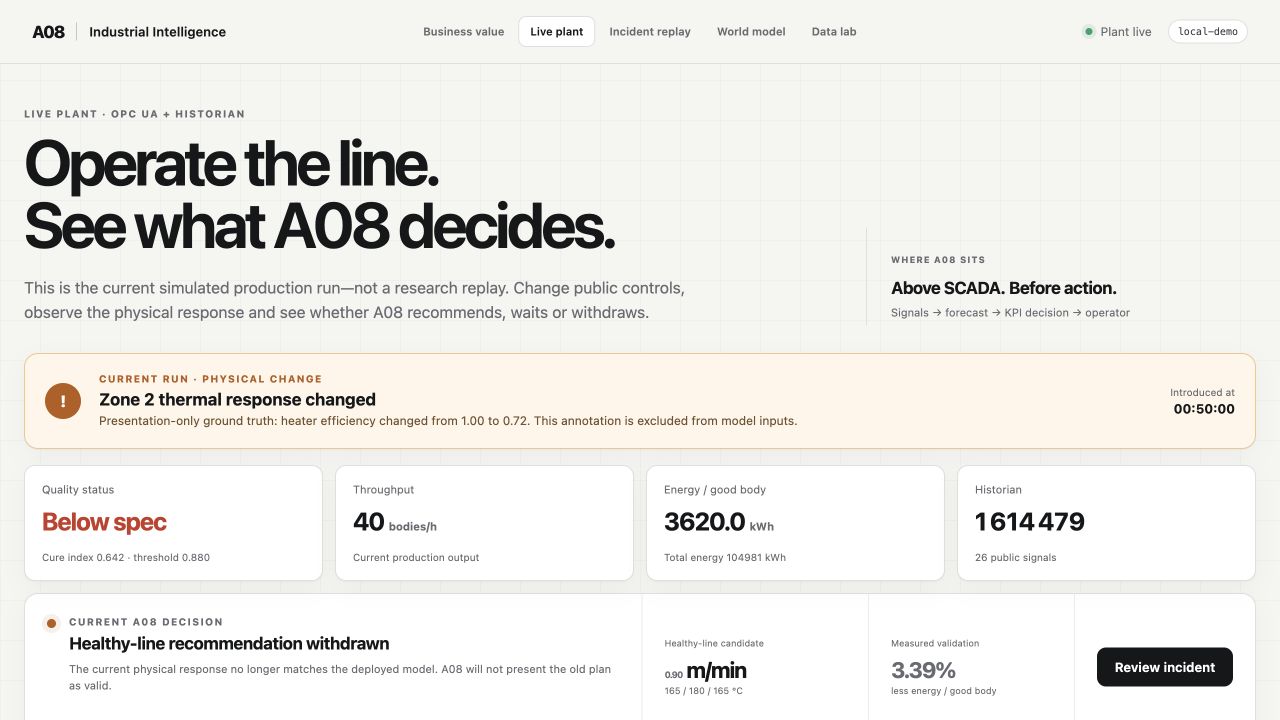
Our first demonstrator is a simulated automotive paint-curing line: a three-zone thermal oven, a controllable conveyor, delayed temperature dynamics, energy consumption, production throughput and a quality outcome for every processed body.
The plant publishes public telemetry through OPC UA. An edge collector stores it in a historian before the model, planner or interface can use it. The model cannot access private simulator state.
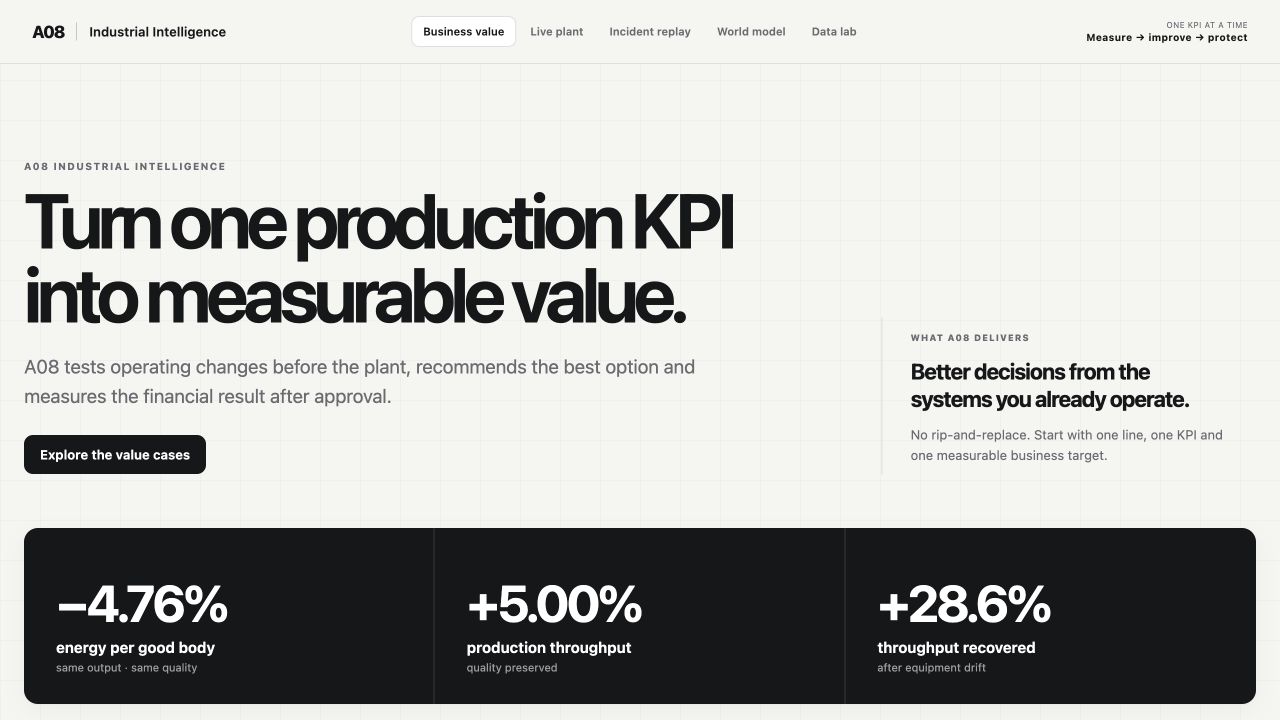
energy per good body at unchanged output and quality
throughput with the energy trade-off made explicit
throughput recovered after conveyor authority loss
Improving a healthy process
One qualified recommendation reduced energy per good body by 4.76% while maintaining 38 bodies per hour and 100% simulated quality. Another increased throughput from 40 to 42 bodies per hour while preserving quality, with its additional energy cost and €3.66 contribution break-even made explicit.
Remaining useful after the process changes
In another scenario, the conveyor continued operating but stopped responding to commands as expected. The old model predicted output the process could no longer deliver. Production fell to 28 bodies per hour.
After the changed relationship was identified through the governed workflow, the system proposed a revised command that recovered 36 bodies per hour while preserving the simulated quality constraint.
06 · What comes next
From a research mechanism to an industrial product.
The direction of A08 has expanded, but the underlying thesis has not changed. We started with model repair because adaptation is one of the hardest and least governed parts of deploying learned dynamics.
We are now building the surrounding system because repair only becomes commercially useful when the model is connected to a real operational objective, trustworthy temporal data, explicit constraints, human authority and measurable outcomes.
The next meaningful step is not a larger simulation. It is applying this architecture to one bounded industrial KPI with accessible operational data, an agreed baseline and recommendations first evaluated in shadow mode.
One process. One KPI. One model. Then expand.
A08 Labs · Industrial Intelligence
Are you operating a process where energy, throughput or quality depends on decisions whose effects unfold over time?
A08 Labs is preparing its first bounded industrial integrations.
Talk to A08